
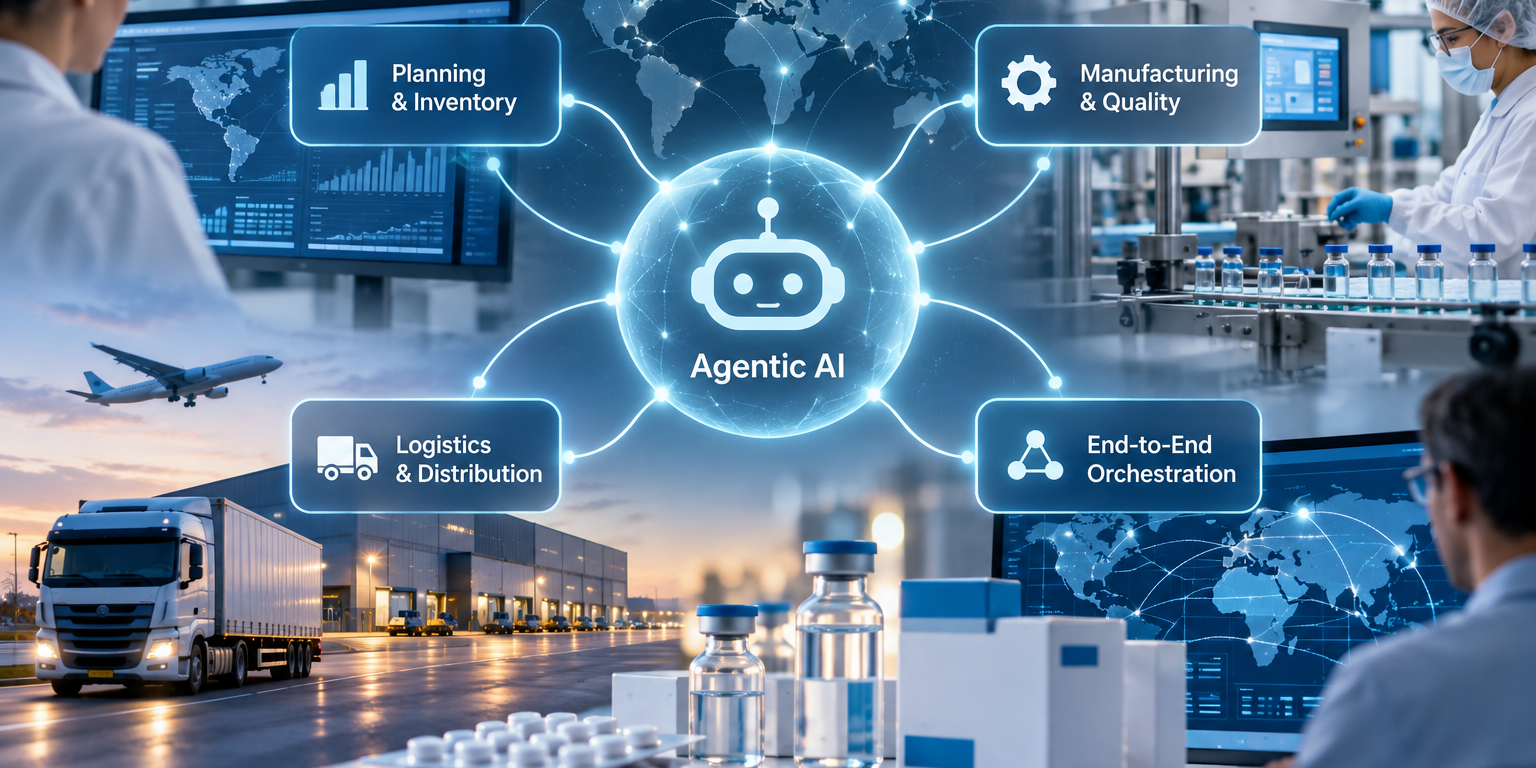
Artificial Intelligence is entering a new phase in pharmaceutical supply chains. Beyond forecasting and analytics, Agentic AI promises to transform how companies anticipate disruptions, coordinate operations and make decisions across increasingly complex global networks.
While traditional AI primarily supports analysis and predictions, Agentic AI introduces intelligent agents capable of interpreting situations, coordinating workflows and initiating actions, within predefined operational and regulatory boundaries.
Several pharmaceutical companies are already exploring or deploying these capabilities.
Pharma companies leading the transformation
- Sanofi is among the most advanced examples, leveraging AI-driven decision intelligence to improve supply chain visibility, anticipate inventory risks and support operational decisions across its global organization.
- Boehringer Ingelheim is exploring AI agents connected to enterprise knowledge graphs, enabling better integration of supply chain, quality and regulatory information.
- Catalent has developed AI-powered capabilities supporting quality investigations, root-cause analysis and corrective actions, demonstrating how intelligent agents can improve manufacturing operations.
- Italfarmaco has implemented an agentic manufacturing execution solution to enhance real-time production visibility and operational decision-making.
These examples reflect different levels of maturity, from AI-assisted decision-making to more advanced agent-based workflows. Fully autonomous supply chain operations remain an emerging ambition.
What could Agentic AI change in pharmaceutical supply chains?
The potential extends across the entire value chain:
- Planning & inventory: Dynamic demand-supply balancing and proactive shortage prevention.
- Manufacturing & quality: Faster deviation management, production adjustments and compliance support.
- Logistics & cold chain: Intelligent exception management and coordinated responses to disruptions.
- End-to-end orchestration: Connecting planning, manufacturing, logistics and distribution decisions across multiple systems and partners.
From AI pilots to operational transformation
The real challenge is not simply introducing AI agents. It is ensuring access to reliable data, interoperability between systems, clear decision-making responsibilities and appropriate human oversight.
In a highly regulated industry, Agentic AI must combine operational autonomy with traceability, compliance and human accountability.
At Biolog Consulting, we believe Agentic AI represents an important next step towards more connected, responsive and resilient life sciences supply chains.
The opportunity is not to replace supply chain professionals, but to enable them to focus on higher-value decisions while intelligent systems manage increasing operational complexity.
The next competitive advantage may not come from having more data, but from turning data into coordinated action.
References & Industry Case Studies
The following industry case studies illustrate how pharmaceutical companies are implementing Agentic AI and AI-driven decision intelligence across their supply chains and manufacturing operations.
- Sanofi – Agentic AI in Supply Chain Planning and Decision Intelligence
Zero100, February 2026
Agentic AI in Action with Sanofi - Boehringer Ingelheim – AI Agents and Supply Chain Knowledge Graphs
Neo4j, 2026
Boehringer Ingelheim: AI Agents on a Pharma Supply Chain Context Graph - Catalent – Agentic AI for Pharmaceutical Quality Management
Catalent, September 2026
Inside Qai: How Catalent Is Teaching AI to Think Like a Quality Expert - Italfarmaco – Agentic AI in Pharmaceutical Manufacturing
Decisyon, Industry Case Study
Italfarmaco: Improving Manufacturing Efficiency with Agentic MES
Biolog Consulting – Connecting expertise, technology and operational excellence across life sciences supply chains.