
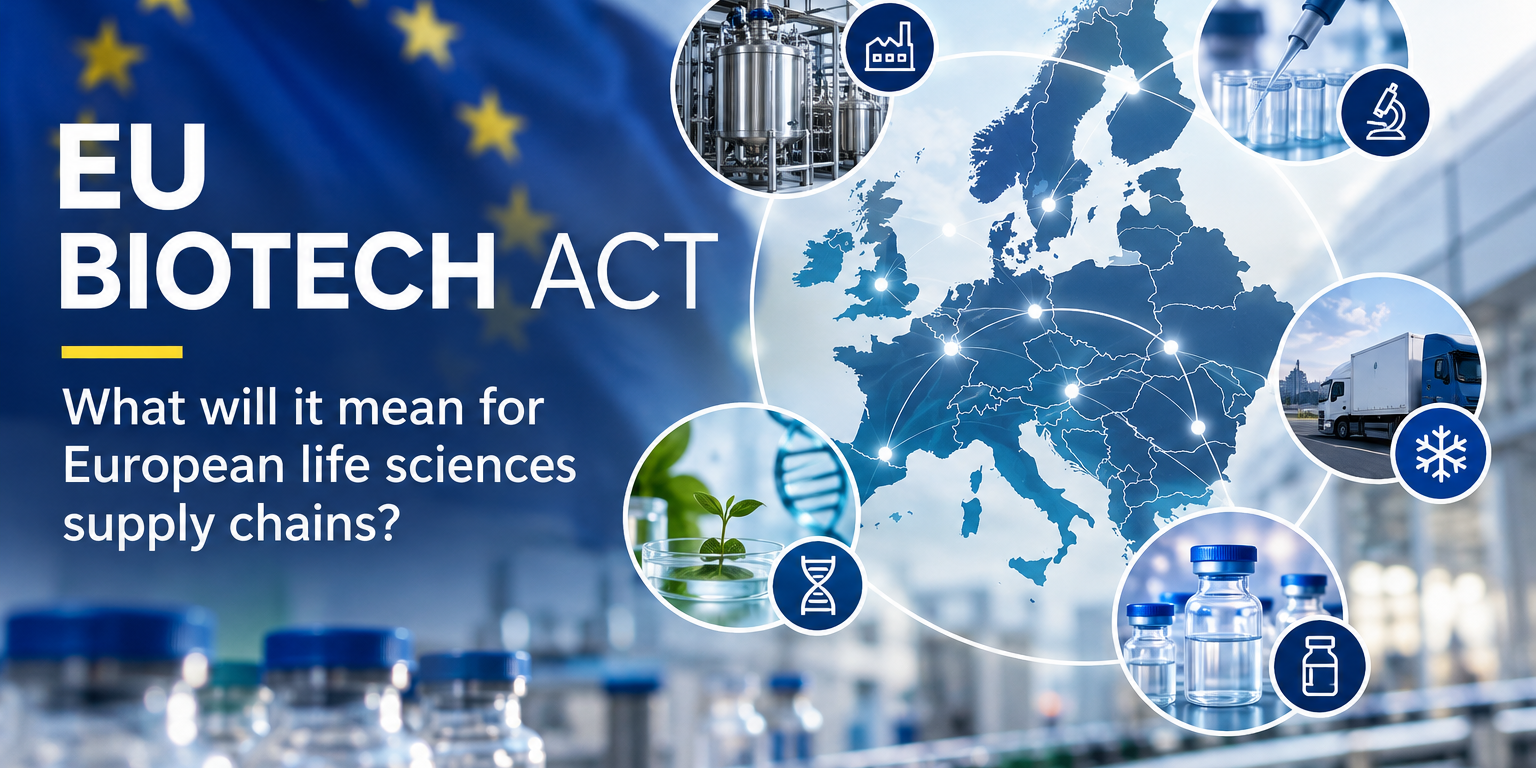
Europe is entering a new phase in its biotechnology strategy. The proposed EU Biotech Act could become an important catalyst for strengthening European competitiveness, accelerating innovation and developing more resilient life sciences supply chains. But what does this mean in practice for the industry?
The European Commission’s proposal for the EU Biotech Act, presented in December 2025, aims to reinforce Europe’s position in biotechnology by supporting innovation, investment, manufacturing capabilities and regulatory simplification.
Beyond research and development, the initiative raises a fundamental question: How can Europe translate its scientific excellence into competitive, integrated and resilient industrial value chains?
From Innovation to Industrial Supply Chains
Europe benefits from world-class research institutions, pharmaceutical companies, biotechnology clusters and specialised industrial capabilities. However, transforming scientific discoveries into commercially available therapies requires much more than innovation alone.
It requires manufacturing capacity, reliable suppliers, specialised logistics, advanced technologies and effective coordination across the entire value chain.
The EU Biotech Act could accelerate developments in several areas:
- European manufacturing and CDMO capabilities: Encouraging investment in biomanufacturing, industrial scale-up and specialised production infrastructure.
- Supply chain resilience: Reducing critical dependencies, diversifying sourcing strategies and strengthening strategic supplier networks.
- Clinical-to-commercial transitions: Supporting more efficient development pathways and better integration between clinical operations, manufacturing and commercial distribution.
- Advanced therapies and new modalities: Developing supply chain models capable of supporting cell and gene therapies, personalised medicine and increasingly complex biological products.
- Digitalisation and AI: Creating opportunities for improved visibility, interoperability, predictive planning and end-to-end supply chain orchestration.
Resilience Does Not Mean Producing Everything in Europe
One of the key challenges will be finding the right balance between European strategic autonomy and globally connected supply chains.
Increasing European manufacturing capacity is important, but resilience cannot be achieved through reshoring alone.
Biotechnology value chains remain international, involving critical raw materials, specialised equipment, technologies, manufacturing partners and logistics providers across multiple regions.
The real objective should be to develop European capabilities while building diversified, flexible and globally connected supply networks.
This requires better visibility over dependencies, stronger supplier partnerships, contingency planning and more integrated industrial ecosystems.
New Opportunities Across the Life Sciences Ecosystem
The potential impact extends beyond pharmaceutical and biotechnology manufacturers.
CDMOs, specialised logistics providers, packaging companies, equipment manufacturers, technology partners and supply chain consulting firms could all play an important role in strengthening Europe’s biotechnology ecosystem.
Regional clusters and investment promotion organisations also have an opportunity to identify missing links in existing value chains and attract international companies capable of filling those gaps.
The challenge is therefore not simply to attract more investment, but to ensure that investments contribute to stronger and more complete industrial ecosystems.
From Ambition to Implementation
The EU Biotech Act remains a legislative proposal, and its practical impact will depend on the final regulatory framework, investment decisions and implementation across Member States.
Nevertheless, companies can already begin preparing by reviewing their manufacturing networks, identifying critical supply chain dependencies, assessing industrial partnerships and anticipating future capacity requirements.
The coming years could bring significant changes in how European biotechnology products are developed, manufactured and distributed.
Biolog Consulting’s Perspective
At Biolog Consulting, we believe that Europe’s biotechnology competitiveness will increasingly depend on its ability to connect innovation with operational excellence and supply chain performance.
Through our international network of supply chain experts and our experience across the life sciences industry, we support organisations in addressing challenges related to supply chain strategy, network design, operational transformation, resilience and clinical-to-commercial development.
The EU Biotech Act represents an opportunity to rethink how European life sciences value chains are designed, connected and managed — not simply where products are manufactured.
Ultimately, Europe’s success will depend on its ability to turn biotechnology innovation into efficient, resilient and globally competitive supply chains.
The question is no longer only what Europe can innovate, but how Europe can industrialise, scale and deliver that innovation to patients worldwide.
Biolog Consulting – Connecting expertise, transforming supply chains.